
 Posted by
 Author: xianfeng, The author only represents his own personal views.
On April 16th, I opened the news and another mass shooting caught my eye: on the evening of April 15th, a large-scale shooting occurred at a 16-year-old birthday party in Dadeville, Alabama, which has resulted in 4 deaths and 20 injuries. This is one of several shootings this year, and I have lost count because I have become numb to this type of news.
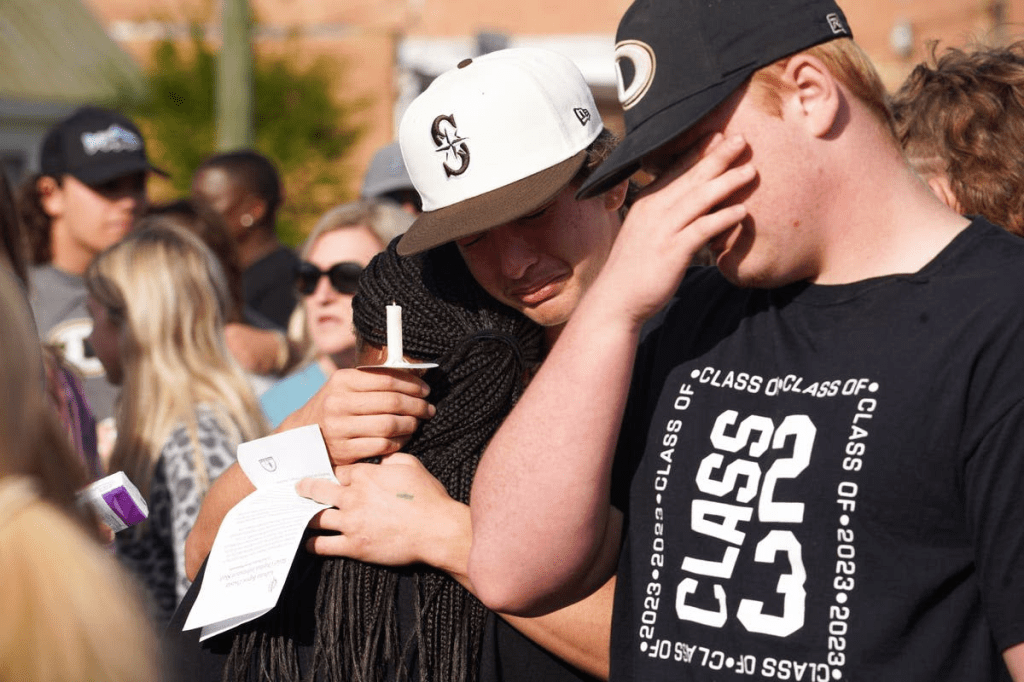
Compared with other countries, the number of gun incidents in the United States is much higher, and the call for gun control is persistent. The two parties in Congress have been arguing about this for years, and it has become a cliché topic.
On June 25th of last year, President Biden signed what was touted by both parties in Congress and some mainstream media as “the first significant federal gun safety legislation in decades.” This significant legislation was referred to as “God’s will, and it will save many lives” and so on so forth.
But this year, gun violence has continued to escalate. According to a website, there have been more than 160 gun violence incidents to date, compared to more than 130 during the same period last year. After the so-called “major federal gun safety legislation” was passed, gun violence did not decrease but instead increased.
The reason for this is that these laws only address trivial matters, such as “investing $750 million to help states implement and operate crisis intervention plans,” “investing more money to strengthen mental health counseling for students and school safety,” which is supposedly aimed at the 2018 high school shooting in Florida, and “encouraging states to use grants to include minors’ records in the national instant criminal background check system,” and so on. All of these are mere window dressing. Some even claim that “we are not against guns, we are only against crime”, which is ridiculous. Can’t guns can make crime faster and more effective?

Here, some people may raise the argument that the Second Amendment to the US Constitution guarantees the right of the American people to keep and bear arms. In fact, the Second Amendment is written as follows:
“A well regulated Militia, being necessary to the security of a free State, the right of the people to keep and bear Arms, shall not be infringed.”
From reading the above text, it is clear that the term “people” refers to those who are willing to receive training and be organized and managed as a militia or group, similar to what is now called the “National Guard” in modern times. It does not refer to just any individual. In history, during China’s resistance against Japan, it was said that “there is no distinction between North and South, young and old, and everyone has the responsibility to defend the country.” Does this mean that just anyone can pick up a gun? No, you still need to participate in a certain armed organization.
And looking at the current situation in the United States, how many people who own guns have joined the National Guard or reserves? How many are willing to fight for the security of their state?
Someone might argue that the Supreme Court of the United States has already made a ruling on the meaning of “the people.” But I would say that the status of these judges themselves does not conform to the definition of the Second Amendment. They themselves are not “well-regulated militia trained and organized” nor have they ever fought for the safety of a free state!
Here, I don’t want to get into a debate about the Second Amendment, but I want to offer a personal suggestion to address the frequent occurrence of gun violence in the United States. Faced with reality, I strongly urge the introduction of a “reference system” in the buying and selling of firearms in the United States.
In life in the United States, there are several things where you must or, in most cases, are required to provide references. Typically, three references are required when you apply to colleges, scholarships, or research assistant positions. The school or supervisor will check your academic performance and character through your references. Additionally, when you apply for a job, a new employer will check your work ability and character through your references. Moreover, when you apply for a rental apartment, you are generally required to provide references. This reference is usually your former landlord, and the new apartment will check your rent-paying reputation and so on through your former landlord.

Of course, even if you provide references, the requesting party may not necessarily check them and instead just keep them on file as a reference. However, if you cannot provide any references, most of your applications may fall through.
Additionally, even if you provide references and the requesting party does check and accepts them, you may not necessarily perform as well as recommended later on. However, in most cases, the performance is usually satisfactory, and it is rare for there to be a significant discrepancy.
However, if we look at the background checks in gun sales in the United States, there often appears to be a significant gap. Frequently, a person with no criminal record or history of mental illness is able to purchase a gun, but then quickly goes on to commit mass shootings. These incidents happen repeatedly, so why does this occur, and how can we address it?
I believe that the background checks for gun sales in the United States, which only look into criminal records and mental health history, rely solely on past records and cannot predict future behavior. People who have not committed crimes in the past may still commit them after acquiring a gun, and individuals who have not had a history of mental illness may still experience it later on. Additionally, these types of checks cannot predict an individual’s paranoid personality or personality disorders, leaving a significant risk for the ongoing occurrence of tragic gun violence.
Now, let’s take a look at some examples as the follows:
First, the 2018 Parkland school shooting in Florida. This refers to a mass shooting that occurred on February 14, 2018 at Marjory Stoneman Douglas High School in the Miami metropolitan area of Florida. The shooting resulted in 17 deaths and 14 hospitalizations, with an additional two students committing suicide, for a total of 19 deaths, making it the deadliest high school shooting in American history. The shooter was a former student of the school, 19-year-old Nikolas Cruz. This was the 18th school shooting in the United States in 2018, and the shooter obtained his firearms legally.
What kind of person was Nikolas Cruz? Based on investigations by the media into surviving teachers and students after the incident, the following picture emerged: Cruz was adopted at the age of two, and his adoptive father died when he was young. His adoptive mother also passed away at the end of 2017. He received psychological counseling but did not attend any sessions before the shooting.

His former math teacher stated that there was an email circulated among teachers from the school administration warning that Cruz had threatened other students, resulting in him being prohibited from carrying a backpack on campus. He was later expelled for fighting with his ex-girlfriend’s boyfriend.
Cruz had joined the Junior Reserve Officers’ Training Corps (JROTC). Classmates reported that he had anger management issues and frequently made jokes about guns and gun violence. Another person said he was “always anxious, always talking about guns, and trying to cover his face.” One student said, “I think everyone had in their minds if anybody was going to do it, it was going to be him.” Some classmates also said he had few friends and kept to himself. In addition, Cruz enjoyed joking about killing animals.
Broward County Sheriff Scott Israel said Cruz’s online presence and accounts were “extremely disturbing,” including numerous pictures and articles of him with weapons such as knives, shotguns, handguns, and BB guns. His YouTube videos contained violent threats, such as “I want to kill a lot of people.”
On January 5, 2018, the FBI public access hotline received a tip from someone close to Cruz. Two days after the shooting on February 16, the FBI issued a statement detailing the tip. The statement said, “The caller provided information about Cruz’s gun ownership, desire to kill people, erratic behavior, and disturbing social media posts, as well as the potential of him conducting a school shooting.” After an investigation, the FBI concluded that the hotline unit did not follow protocols by not submitting the tip to the Miami field office for further investigation.
So, it is clear from all of this that the FBI had received abnormal reports about the shooter, but due to internal negligence, they did not conduct a timely investigation, which led to the tragedy. The on-site school police officers also did not fulfill their duties and intervene effectively during the incident, which led to the escalation of the casualties. These were all accidental factors. However, it was a common consensus among those close to the shooter that he had an eccentric and violent personality. If, in addition to the traditional criminal and mental health history checks, there was a “reference check” when he purchased the gun, then the firearm would most likely never have ended up in his hands.
The second incident refers to the mass shooting that took place on October 1, 2017, at the Route 91 Harvest outdoor country music festival in Las Vegas, Nevada. The shooting resulted in 61 deaths (including the perpetrator) and 500 to 851 injuries, with approximately 422 people suffering from gunshot wounds. It is the deadliest mass shooting in American history to date.
Let’s take a look at the perpetrator. He was a retired accountant named Stephen Paddock, who was 64 years old at the time of the shooting. He lived in a retirement community in Mesquite, Nevada with his mother, and together they owned and managed several apartment buildings. He also owned two planes and was a licensed pilot. After the shooting, police found a large number of firearms, ammunition (some with bump stocks and high-capacity magazines), and explosive devices in his home and car.
Unlike the previous perpetrator Cruz, who had at least some acquaintances who could describe him to some extent, nobody could even describe Paddock a little. He was so reclusive that he didn’t even interact with his brothers. While Cruz had at least some connection to the security of a Free State, Paddock had no such connection at all. If Paddock had been required to provide a “reference” when buying guns, it would have been difficult for him to find anyone, given his reclusiveness. The police ultimately closed the case with an unclear motive.
The third case is the Virginia Tech shooting that occurred on April 16, 2007, at Virginia Polytechnic Institute and State University in the United States. There were two shooting incidents that resulted in the deaths of 33 people, including the perpetrator, and at least 23 others injured. It is the deadliest campus shooting in U.S. history and the third deadliest shooting in U.S. history (after the 2017 Las Vegas shooting and the 2016 Orlando nightclub shooting), with a death toll exceeding the 1991 Luby’s shooting that killed 24 people.
The shooter was a Korean-American student named Zhao Chengxi, who grew up in Virginia and was a senior majoring in English at Virginia Tech at the time of the shooting. He eventually committed suicide.
What kind of person was Zhao Chengxi? Let’s take a look:
Zhao Chengxi was born in South Korea in September 1992 and immigrated to Detroit, Michigan with his parents at the age of 8. According to Virginia Tech, he was a senior undergraduate student majoring in English. He was a South Korean citizen and held a US permanent residency, residing in Centreville, Virginia in the Washington DC area at the time.

In 2005, Zhao was briefly detained by authorities in Virginia and underwent a psychological evaluation, which found him to be mentally unstable and a threat to his own life. A judge ordered him to receive treatment at a county hospital’s psychiatric clinic, where doctors diagnosed him with severe depression.
After the shooting incident, a spokesperson for Virginia Tech described Zhao as a “loner,” and said the university had difficulty finding information about him. There was a Korean student club on campus, but the club’s director said Zhao never spoke to other Korean students. Earlier, someone had reported Zhao for setting a fire in his dorm room, and two female students reported to the police that they had been followed by Zhao on campus. A female classmate reported that Zhao had taken pictures of them with his phone without their consent.
Another classmate described Zhao as a “quiet” person who never responded to greetings from others. Julie Poole, a former classmate, said on the first day of their literature class, each student introduced themselves, but Zhao just sat there and did not say a word.
Two students who had shared a dorm with Zhao said that he had indeed followed their male friends who had female partners and sometimes stood outside his own dorm room at night to take pictures of passersby. He also frequently made harassing phone calls to classmates claiming to be “Zhao’s brother.”
Stephanie Derry, a former classmate, also said that Zhao never participated in class discussions, and she said: “He just sat there, and I couldn’t describe it. He just sat there watching us discuss, and he never said a word. It was his lack of expression that made him stand out. I only remember him laughing once, and it wasn’t a big laugh.”
Nikki Giovanni, who taught Zhao a poetry class, had expelled him from the class because of his threatening behavior and described him as having a “mean” temper and being a pile of problematic “crap.” When she heard about the campus massacre, she said: “I already had a hunch that it was probably him. It would have surprised me if it wasn’t.”
Based on this information, Zhao appears to be a person with a reclusive and peculiar personality. If he was asked to provide a “reference” when purchasing a gun, can he find one to provide?
There was also the sensational case of Chinese international student Lu Gang’s shooting in 1994. He was also a solitary and arrogant figure who couldn’t get along with his teachers and classmates. If he was asked to provide a “reference” when buying a gun, he would also be unable to find anyone.

Of course, these two individuals cannot even be considered as “the American people”, let alone be close to the Second Amendment!
Someone might argue that even a person who can provide sufficient “reference” and is friendly can still commit a crime after buying a gun. Yes, but in practical cases, this probability is not high.
Then, introducing a “reference system” in gun sales, can it solve all the problems? Of course not, but just like using a “reference system” in college admissions, scholarship applications, job applications, and rental applications, it can capture things that criminal and mental health history investigations cannot capture, and it can make things relatively optimal in outcome!
Some people may argue that implementing a “reference system” for gun sales would be equivalent to depriving them of their constitutional right to bear arms. To those people, I would ask: when others apply for admission to schools, scholarships, jobs, or rental properties, and are required to provide a “reference”, are their constitutional rights being violated as well?
Therefore, in light of the abuse of the Second Amendment of the Constitution today, I strongly urge:
“The introduction of a “references system” in the sale of firearms in the United States should be required and necessary!”
 Yi-Radio